


While conventional search engines ranked results by counting how many times the search terms appeared on the page, the two theorized about a better system that analyzed the relationships between websites. They called this new technology PageRank, where a website's relevance was determined by the number of pages, and the importance of those pages, that linked back to the original site.
A small search engine called "RankDex" from IDD Information Services designed by Robin Li was, since 1996, already exploring a similar strategy for site-scoring and page ranking. The technology in RankDex would be patented and used later when Li founded Baidu in China.
Page and Brin originally nicknamed their new search engine "BackRub", because the system checked backlinks to estimate the importance of a site.
Eventually, they changed the name to Google, originating from a misspelling of the word "googol", the number one followed by one hundred zeros, which was picked to signify that the search engine wants to provide large quantities of information for people. Originally, Google ran under the Stanford University website, with the domain google.stanford.edu.
The domain name for Google was registered on September 15, 1997, and the company was incorporated on September 4, 1998. It was based in a friend's (Susan Wojcicki) garage in Menlo Park, California. Craig Silverstein, a fellow PhD student at Stanford, was hired as the first employee.
In May 2011, unique visitors of Google surpassed 1 billion mark for the first time, an 8.4 percent increase from a year ago with 931 million unique visitors.
Financing and initial public offering

 Google's initial public offering (IPO) took place five years later on August 19, 2004. The company offered 19,605,052 shares at a price of $85 per share. Shares were sold in a unique online auction format using a system built by Morgan Stanley and Credit Suisse, underwriters for the deal.[50][51] The sale of $1.67 billion gave Google a market capitalization of more than $23 billion.
The vast majority of the 271 million shares remained under the control
of Google, and many Google employees became instant paper millionaires. Yahoo!, a competitor of Google, also benefited because it owned 8.4 million shares of Google before the IPO took place.
Some people speculated that Google's IPO would inevitably lead to changes in company culture. Reasons ranged from shareholder pressure for employee benefit reductions to the fact that many company executives would become instant paper millionaires. As a reply to this concern, co-founders Sergey Brin and Larry Page promised in a report to potential investors that the IPO would not change the company's culture. In 2005, however, articles in The New York Times and other sources began suggesting that Google had lost its anti-corporate, no evil philosophy.[56][57][58] In an effort to maintain the company's unique culture, Google designated a Chief Culture Officer, who also serves as the Director of Human Resources. The purpose of the Chief Culture Officer is to develop and maintain the culture and work on ways to keep true to the core values that the company was founded on: a flat organization with a collaborative environment. Google has also faced allegations of sexism and ageism from former employees.
The stock's performance after the IPO went well, with shares hitting $700 for the first time on October 31, 2007, primarily because of strong sales and earnings in the online advertising market. The surge in stock price was fueled mainly by individual investors, as opposed to large institutional investors and mutual funds. The company is now listed on the NASDAQ stock exchange under the ticker symbol GOOG and under the Frankfurt Stock Exchange under the ticker symbol GGQ1.
Growth
In March 1999, the company moved its offices to Palo Alto, California, home to several other noted Silicon Valley technology startups. The next year, against Page and Brin's initial opposition toward an advertising-funded search engine, Google began selling advertisements associated with search keywords. In order to maintain an uncluttered page design and increase speed, advertisements were solely text-based. Keywords were sold based on a combination of price bids and click-throughs, with bidding starting at five cents per click. This model of selling keyword advertising was first pioneered by Goto.com, an Idealab spin-off created by Bill Gross. When the company changed names to Overture Services, it sued Google over alleged infringements of the company's pay-per-click and bidding patents. Overture Services would later be bought by Yahoo! and renamed Yahoo! Search Marketing. The case was then settled out of court, with Google agreeing to issue shares of common stock to Yahoo! in exchange for a perpetual license.During this time, Google was granted a patent describing its PageRank mechanism. The patent was officially assigned to Stanford University and lists Lawrence Page as the inventor. In 2003, after outgrowing two other locations, the company leased its current office complex from Silicon Graphics at 1600 Amphitheatre Parkway in Mountain View, California. The complex has since come to be known as the Googleplex, a play on the word googolplex, the number one followed by a googol zeroes. Three years later, Google would buy the property from SGI for $319 million. By that time, the name "Google" had found its way into everyday language, causing the verb "google" to be added to the Merriam Webster Collegiate Dictionary and the Oxford English Dictionary, denoted as "to use the Google search engine to obtain information on the Internet."
Acquisitions and partnerships
See also: List of acquisitions by Google
Since 2001, Google has acquired many companies, mainly focusing on small venture capital companies. In 2004, Google acquired Keyhole, Inc. The start-up company developed a product called Earth Viewer that gave a 3-D view of the Earth. Google renamed the service to Google Earth in 2005. Two years later, Google bought the online video site YouTube for $1.65 billion in stock. On April 13, 2007, Google reached an agreement to acquire DoubleClick for $3.1 billion, giving Google valuable relationships that DoubleClick had with Web publishers and advertising agencies. Later that same year, Google purchased GrandCentral for $50 million. The site would later be changed over to Google Voice.
On August 5, 2009, Google bought out its first public company,
purchasing video software maker On2 Technologies for $106.5 million. Google also acquired Aardvark,
a social network search engine, for $50 million, and commented on their
internal blog, "we're looking forward to collaborating to see where we
can take it". In April 2010, Google announced it had acquired a hardware startup, Agnilux.In addition to the numerous companies Google has purchased, the company has partnered with other organizations for everything from research to advertising. In 2005, Google partnered with NASA Ames Research Center to build 1,000,000 square feet (93,000 m2) of offices. The offices would be used for research projects involving large-scale data management, nanotechnology, distributed computing, and the entrepreneurial space industry. Later that year, Google entered into a partnership with Sun Microsystems in October 2005 to help share and distribute each other's technologies. The company also partnered with AOL of Time Warner, to enhance each other's video search services. Google's 2005 partnerships also included financing the new .mobi top-level domain for mobile devices, along with other companies including Microsoft, Nokia, and Ericsson. Google would later launch "Adsense for Mobile", taking advantage of the emerging mobile advertising market. Increasing their advertising reach even further, Google and Fox Interactive Media of News Corporation entered into a $900 million agreement to provide search and advertising on popular social networking site MySpace.
In October 2006, Google announced that it had acquired the video-sharing site YouTube for US$1.65 billion in Google stock, and the deal was finalized on November 13, 2006. Google does not provide detailed figures for YouTube's running costs, and YouTube's revenues in 2007 were noted as "not material" in a regulatory filing. In June 2008, a Forbes magazine article projected the 2008 YouTube revenue at US$200 million, noting progress in advertising sales. In 2007, Google began sponsoring NORAD Tracks Santa, a service that pretends to follow Santa Claus' progress on Christmas Eve, using Google Earth to "track Santa" in 3-D for the first time, and displacing former sponsor AOL. Google-owned YouTube gave NORAD Tracks Santa its own channel.
In 2008, Google developed a partnership with GeoEye to launch a satellite providing Google with high-resolution (0.41 m monochrome, 1.65 m color) imagery for Google Earth. The satellite was launched from Vandenberg Air Force Base on September 6, 2008. Google also announced in 2008 that it was hosting an archive of Life Magazine's photographs as part of its latest partnership. Some of the images in the archive were never published in the magazine. The photos were watermarked and originally had copyright notices posted on all photos, regardless of public domain status.
In 2010, Google Energy made its first investment in a renewable-energy project, putting up $38.8 million into two wind farms in North Dakota. The company announced the two locations will generate 169.5 megawatts of power, or enough to supply 55,000 homes. The farms, which were developed by NextEra Energy Resources, will reduce fossil fuel use in the region and return profits. NextEra Energy Resources sold Google a twenty percent stake in the project in order to get funding for project development. Also in 2010, Google purchased Global IP Solutions, a Norway based company that provides web-based teleconferencing and other related services. This acquisition will enable Google to add telephone-style services to its list of products. On May 27, 2010, Google announced it had also closed the acquisition of the mobile ad network, AdMob. This purchase occurred days after the Federal Trade Commission closed its investigation into the purchase. Google acquired the company for an undisclosed amount. In July 2010, Google signed an agreement with an Iowa wind farm to buy 114 megawatts of energy for 20 years.
On April 4, 2011 The Globe and Mail reported that Google bid $900-million for six thousand Nortel Networks patents.
Products and services
See also: List of Google products
Advertising
Ninety-nine percent of Google's revenue is derived from its advertising programs. For the 2006 fiscal year, the company reported $10.492 billion in total advertising revenues and only $112 million in licensing and other revenues. Google has implemented various innovations in the online advertising market that helped make them one of the biggest brokers in the market. Using technology from the company DoubleClick, Google can determine user interests and target advertisements so they are relevant to their context and the user that is viewing them. Google Analytics allows website owners to track where and how people use their website, for example by examining click rates for all the links on a page. Google advertisements can be placed on third-party websites in a two-part program. Google's AdWords allows advertisers to display their advertisements in the Google content network, through either a cost-per-click or cost-per-view scheme. The sister service, Google AdSense, allows website owners to display these advertisements on their website, and earn money every time ads are clicked.One of the disadvantages and criticisms of this program is Google's inability to combat click fraud, when a person or automated script "clicks" on advertisements without being interested in the product, which causes that advertiser to pay money to Google unduly. Industry reports in 2006 claim that approximately 14 to 20 percent of clicks were in fact fraudulent or invalid. Furthermore, there has been controversy over Google's "search within a search", where a secondary search box enables the user to find what they are looking for within a particular website. It was soon reported that when performing a search within a search for a specific company, advertisements from competing and rival companies often showed up along with those results, drawing users away from the site they were originally searching. Another complaint against Google's advertising is their censorship of advertisers, though many cases concern compliance with the Digital Millennium Copyright Act. For example, in February 2003, Google stopped showing the advertisements of Oceana, a non-profit organization protesting a major cruise ship's sewage treatment practices. Google cited its editorial policy at the time, stating "Google does not accept advertising if the ad or site advocates against other individuals, groups, or organizations." The policy was later changed. In June 2008, Google reached an advertising agreement with Yahoo!, which would have allowed Yahoo! to feature Google advertisements on their web pages. The alliance between the two companies was never completely realized due to antitrust concerns by the U.S. Department of Justice. As a result, Google pulled out of the deal in November 2008.
In an attempt to advertise its own products, Google launched a website called Demo Slam, developed to demonstrate technology demos of Google Products. Each week, two teams compete at putting Google's technology into new contexts. Search Engine Journal said Demo Slam is "a place where creative and tech-savvy people can create videos to help the rest of the world understand all the newest and greatest technology out there."
Search engine
 Google Search, a web search engine, is the company's most popular service. According to market research published by comScore in November 2009, Google is the dominant search engine in the United States market, with a market share of 65.6%. Google indexes billions
of web pages, so that users can search for the information they desire,
through the use of keywords and operators. Despite its popularity, it
has received criticism from a number of organizations. In 2003, The New York Times complained about Google's indexing, claiming that Google's caching of content on their site infringed on their copyright for the content. In this case, the United States District Court of Nevada ruled in favor of Google in Field v. Google and Parker v. Google.[120][121] Furthermore, the publication 2600: The Hacker Quarterly has compiled a list of words that the web giant's new instant search feature will not search.
Google Watch has also criticized Google's PageRank algorithms, saying
that they discriminate against new websites and favor established sites, and has made allegations about connections between Google and the NSA and the CIA.
Despite criticism, the basic search engine has spread to specific
services as well, including an image search engine, the Google News
search site, Google Maps, and more. In early 2006, the company launched
Google Video, which allowed users to upload, search, and watch videos
from the Internet.
In 2009, however, uploads to Google Video were discontinued so that
Google could focus more on the search aspect of the service. The company even developed Google Desktop,
a desktop search application used to search for files local to one's
computer. Google's most recent development in search is their
partnership with the United States Patent and Trademark Office to create Google Patents, which enables free access to information about patents and trademarks.
One of the more controversial search services Google hosts is Google Books. The company began scanning books and uploading limited previews, and full books where allowed, into their new book search engine. The Authors Guild, a group that represents 8,000 U.S. authors, filed a class action suit in a New York City federal court against Google in 2005 over this new service. Google replied that it is in compliance with all existing and historical applications of copyright laws regarding books. Google eventually reached a revised settlement in 2009 to limit its scans to books from the U.S., the UK, Australia and Canada. Furthermore, the Paris Civil Court ruled against Google in late 2009, asking them to remove the works of La Martinière (Éditions du Seuil) from their database. In competition with Amazon.com, Google plans to sell digital versions of new books. Similarly, in response to newcomer Bing, on July 21, 2010, Google updated their image search to display a streaming sequence of thumbnails that enlarge when pointed at. Though web searches still appear in a batch per page format, on July 23, 2010, dictionary definitions for certain English words began appearing above the linked results for web searches. Google's algorithm was changed in March 2011, giving more weight to high-quality content possibly by the use of n-grams to remove spun content.
Productivity tools
In addition to its standard web search services, Google has released over the years a number of online productivity tools. Gmail, a free webmail service provided by Google, was launched as an invitation-only beta program on April 1, 2004, and became available to the general public on February 7, 2007. The service was upgraded from beta status on July 7, 2009, at which time it had 146 million users monthly. The service would be the first online email service with one gigabyte of storage, and the first to keep emails from the same conversation together in one thread, similar to an Internet forum. The service currently offers over 7400 MB of free storage with additional storage ranging from 20 GB to 16 TB available for US$0.25 per 1 GB per year. Furthermore, software developers know Gmail for its pioneering use of AJAX, a programming technique that allows web pages to be interactive without refreshing the browser. One criticism of Gmail has been the potential for data disclosure, a risk associated with many online web applications. Steve Ballmer (Microsoft's CEO), Liz Figueroa, Mark Rasch, and the editors of Google Watch believe the processing of email message content goes beyond proper use, but Google claims that mail sent to or from Gmail is never read by a human being beyond the account holder, and is only used to improve relevance of advertisements.Google Docs, another part of Google's productivity suite, allows users to create, edit, and collaborate on documents in an online environment, not dissimilar to Microsoft Word. The service was originally called Writely, but was obtained by Google on March 9, 2006, where it was released as an invitation-only preview. On June 6 after the acquisition, Google created an experimental spreadsheet editing program, which would be combined with Google Docs on October 10. A program to edit presentations would complete the set on September 17, 2007, before all three services were taken out of beta along with Gmail, Google Calendar and all products from the Google Apps Suite on July 7, 2009.
Enterprise products
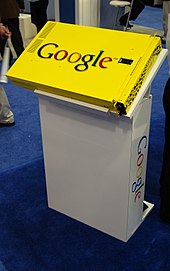
Google's search appliance at the 2008 RSA Conference
 Another one of Google's enterprise products is Google Apps Premier
Edition. The service, and its accompanying Google Apps Education Edition
and Standard Edition, allow companies, schools, and other organizations
to bring Google's online applications, such as Gmail and Google
Documents, into their own domain. The Premier Edition specifically
includes extras over the Standard Edition such as more disk space, API
access, and premium support, and it costs $50 per user per year. A large
implementation of Google Apps with 38,000 users is at Lakehead University in Thunder Bay, Ontario, Canada. In the same year Google Apps was launched, Google acquired Postini and proceeded to integrate the company's security technologies into Google Apps under the name Google Postini Services.
Other products
Google Translate is a server-side machine translation service, which can translate between 35 different languages. Browser extensions allow for easy access to Google Translate from the browser. The software uses corpus linguistics techniques, where the program "learns" from professionally translated documents, specifically UN and European Parliament proceedings. Furthermore, a "suggest a better translation" feature accompanies the translated text, allowing users to indicate where the current translation is incorrect or otherwise inferior to another translation.Google launched its Google News service in 2002. The site proclaimed that the company had created a "highly unusual" site that "offers a news service compiled solely by computer algorithms without human intervention. Google employs no editors, managing editors, or executive editors." The site hosted less licensed news content than Yahoo! News, and instead presented topically selected links to news and opinion pieces along with reproductions of their headlines, story leads, and photographs. The photographs are typically reduced to thumbnail size and placed next to headlines from other news sources on the same topic in order to minimize copyright infringement claims. Nevertheless, Agence France Presse sued Google for copyright infringement in federal court in the District of Columbia, a case which Google settled for an undisclosed amount in a pact that included a license of the full text of AFP articles for use on Google News.
In 2006, Google made a bid to offer free wireless broadband access throughout the city of San Francisco along with Internet service provider EarthLink. Large telecommunications companies such as Comcast and Verizon opposed such efforts, claiming it was "unfair competition" and that cities would be violating their commitments to offer local monopolies to these companies. In his testimony before Congress on network neutrality in 2006, Google's Chief Internet Evangelist Vint Cerf blamed such tactics on the fact that nearly half of all consumers lack meaningful choice in broadband providers. Google currently offers free wi-fi access in its hometown of Mountain View, California.
One year later, reports surfaced that Google was planning the release of its own mobile phone, possibly a competitor to Apple's iPhone. The project, called Android, turned out not to be a phone but an operating system for mobile devices, which Google acquired and then released as an open source project under the Apache 2.0 license. Google provides a software development kit for developers so applications can be created to be run on Android-based phone. In September 2008, T-Mobile released the G1, the first Android-based phone. More than a year later on January 5, 2010, Google released an Android phone under its own company name called the Nexus One.
Other projects Google has worked on include a new collaborative communication service, a web browser, and even a mobile operating system. The first of these was first announced on May 27, 2009. Google Wave was described as a product that helps users communicate and collaborate on the web. The service is Google's "email redesigned", with realtime editing, the ability to embed audio, video, and other media, and extensions that further enhance the communication experience. Google Wave was previously in a developer's preview, where interested users had to be invited to test the service, but was released to the general public on May 19, 2010, at Google's I/O keynote. On September 1, 2008, Google pre-announced the upcoming availability of Google Chrome, an open source web browser, which was then released on September 2, 2008. The next year, on July 7, 2009, Google announced Google Chrome OS, an open source Linux-based operating system that includes only a web browser and is designed to log users into their Google account.
In 2011, Google announced that it will unveil Google Wallet, a mobile application for wireless payments.
In 2011, Google announced they were working on a social networking service called Google+.
Corporate affairs and culture


 Google is known for having an informal corporate culture. On Fortune magazine's list of best companies to work for, Google ranked first in 2007 and 2008 and fourth in 2009 and 2010.
Google was also nominated in 2010 to be the world’s most attractive
employer to graduating students in the Universum Communications talent
attraction index.
Google's corporate philosophy embodies such casual principles as "you
can make money without doing evil," "you can be serious without a suit,"
and "work should be challenging and the challenge should be fun."
Employees
Google's stock performance following its initial public offering has enabled many early employees to be competitively compensated. After the company's IPO, founders Sergey Brin and Larry Page and CEO Eric Schmidt requested that their base salary be cut to $1. Subsequent offers by the company to increase their salaries have been turned down, primarily because their main compensation continues to come from owning stock in Google. Before 2004, Schmidt was making $250,000 per year, and Page and Brin each earned a salary of $150,000.In 2007 and through early 2008, several top executives left Google. In October 2007, former chief financial officer of YouTube Gideon Yu joined Facebook along with Benjamin Ling, a high-ranking engineer. In March 2008, Sheryl Sandberg, then vice-president of global online sales and operations, began her position as chief operating officer of Facebook while Ash ElDifrawi, formerly head of brand advertising, left to become chief marketing officer of Netshops, an online retail company that was renamed Hayneedle in 2009. On April 4, 2011 Larry Page became CEO and Eric Schmidt became Executive Chairman of Google.
As a motivation technique, Google uses a policy often called Innovation Time Off, where Google engineers are encouraged to spend 20% of their work time on projects that interest them. Some of Google's newer services, such as Gmail, Google News, Orkut, and AdSense originated from these independent endeavors. In a talk at Stanford University, Marissa Mayer, Google's Vice President of Search Products and User Experience, showed that half of all new product launches at the time had originated from the Innovation Time Off.
On March 2011, consulting firm Universum released data that Google ranks the first on list of ideal employers by nearly 25 percent chosen from more than 10,000 young professionals asked.
Googleplex

Main article: Googleplex
 Google's headquarters in Mountain View, California is referred to as "the Googleplex", a play on words on the number googolplex and the headquarters itself being a complex of buildings. The lobby is decorated with a piano, lava lamps,
old server clusters, and a projection of search queries on the wall.
The hallways are full of exercise balls and bicycles. Each employee has
access to the corporate recreation center. Recreational amenities are
scattered throughout the campus and include a workout room with weights
and rowing machines, locker rooms, washers and dryers, a massage room,
assorted video games, table football,
a baby grand piano, a billiard table, and ping pong. In addition to the
rec room, there are snack rooms stocked with various foods and drinks,
with special emphasis placed on nutrition. Free food is available to employees 24/7, with paid vending machines prorated favoring nutritional value.
In 2006, Google moved into 311,000 square feet (28,900 m2) of office space in New York City, at 111 Eighth Avenue in Manhattan. The office was specially designed and built for Google, and it now houses its largest advertising sales team, which has been instrumental in securing large partnerships. In 2003, they added an engineering staff in New York City, which has been responsible for more than 100 engineering projects, including Google Maps, Google Spreadsheets, and others. It is estimated that the building costs Google $10 million per year to rent and is similar in design and functionality to its Mountain View headquarters, including table football, air hockey, and ping-pong tables, as well as a video game area. In November 2006, Google opened offices on Carnegie Mellon's campus in Pittsburgh, focusing on shopping related advertisement coding and smartphone applications and programs.By late 2006, Google also established a new headquarters for its AdWords division in Ann Arbor, Michigan.Furthermore, Google has offices all around the world, and in the United States, including Atlanta, Austin, Boulder, San Francisco, Seattle, and Washington DC.

 Google is taking steps to ensure that their operations are
environmentally sound. In October 2006, the company announced plans to
install thousands of solar panels to provide up to 1.6 megawatts of electricity, enough to satisfy approximately 30% of the campus' energy needs.
The system will be the largest solar power system constructed on a U.S.
corporate campus and one of the largest on any corporate site in the
world.
In addition, Google announced in 2009 that it was deploying herds of
goats to keep grassland around the Googleplex short, helping to prevent
the threat from seasonal bush fires while also reducing the carbon
footprint of mowing the extensive grounds. The idea of trimming lawns using goats originated from R. J. Widlar, an engineer who worked for National Semiconductor. Despite this, Google has faced accusations in Harper's Magazine
of being extremely excessive with their energy usage, and were accused
of employing their "Don't be evil" motto as well as their very public
energy saving campaigns as means of trying to cover up or make up for
the massive amounts of energy their servers actually require.
Easter eggs and April Fools' Day jokes
Main article: Google's hoaxes
Google has a tradition of creating April Fools' Day jokes. For example, Google MentalPlex allegedly featured the use of mental power to search the web. In 2007, Google announced a free Internet service called TiSP, or Toilet Internet Service Provider, where one obtained a connection by flushing one end of a fiber-optic cable down their toilet. Also in 2007, Google's Gmail page displayed an announcement for Gmail Paper, allowing users to have email messages printed and shipped to them. In 2008 Google announced Gmail Custom time where users could change the time that the email was sent In 2010, Google jokingly changed its company name to Topeka in honor of Topeka, Kansas,
whose mayor actually changed the city's name to Google for a short
amount of time in an attempt to sway Google's decision in its new Google Fiber Project.
In 2011, Google announced Gmail Motion, an interactive way of
controlling Gmail and the computer with body movements via the user's
webcam.In addition to April Fools' Day jokes, Google's services contain a number of Easter eggs. For instance, Google included the Swedish Chef's "Bork bork bork," Pig Latin, "Hacker" or leetspeak, Elmer Fudd, and Klingon as language selections for its search engine. In addition, the search engine calculator provides the Answer to the Ultimate Question of Life, the Universe, and Everything from Douglas Adams' The Hitchhiker's Guide to the Galaxy. Furthermore, when searching the word "recursion", the spell-checker's result for the properly spelled word is exactly the same word, creating a recursive link. Likewise, when searching for the word "anagram," meaning a rearrangement of letters from one word to form other valid words, Google's suggestion feature displays "Did you mean: nag a ram?" In Google Maps, searching for directions between places separated by large bodies of water, such as Los Angeles and Tokyo, results in instructions to "kayak across the Pacific Ocean." During FIFA World Cup 2010, search queries like "World Cup", "FIFA", etc. caused the "Goooo...gle" page indicator at the bottom of every result page to read "Goooo...al!" instead.
Philanthropy
Main article: Google.org
In 2004, Google formed the not-for-profit philanthropic Google.org, with a start-up fund of $1 billion. The mission of the organization is to create awareness about climate change, global public health, and global poverty. One of its first projects was to develop a viable plug-in hybrid electric vehicle that can attain 100 miles per gallon. Google hired Dr. Larry Brilliant as the program's executive director in 2004 and the current director is Megan Smith.In 2008 Google announced its "project 10100" which accepted ideas for how to help the community and then allowed Google users to vote on their favorites. After two years of silence, during which many wondered what had happened to the program, Google revealed the winners of the project, giving a total of ten million dollars to various ideas ranging from non-profit organizations that promote education to a website that intends to make all legal documents public and online.
In 2011, Google donated 1 million euros to International Mathematical Olympiad to support the next five annual International Mathematical Olympiads (2011–2015).
Network neutrality
Google is a noted supporter of network neutrality. According to Google's Guide to Net Neutrality:Network neutrality is the principle that Internet users should be in control of what content they view and what applications they use on the Internet. The Internet has operated according to this neutrality principle since its earliest days... Fundamentally, net neutrality is about equal access to the Internet. In our view, the broadband carriers should not be permitted to use their market power to discriminate against competing applications or content. Just as telephone companies are not permitted to tell consumers who they can call or what they can say, broadband carriers should not be allowed to use their market power to control activity online.On February 7, 2006, Vint Cerf, a co-inventor of the Internet Protocol (IP), and current Vice President and "Chief Internet Evangelist" at Google, in testimony before Congress, said, "allowing broadband carriers to control what people see and do online would fundamentally undermine the principles that have made the Internet such a success."
Privacy
Eric Schmidt, Google’s chief executive, said 2007 in an interview with the Financial Times: "The goal is to enable Google users to be able to ask the question such as ‘What shall I do tomorrow?’ and ‘What job shall I take?'". Schmidt reaffirmed this 2010 in an interview with the Wall Street Journal: "I actually think most people don't want Google to answer their questions, they want Google to tell them what they should be doing next."On December 2009, Google's CEO, Eric Schmidt, declared after privacy concerns: "If you have something that you don't want anyone to know, maybe you shouldn't be doing it in the first place. If you really need that kind of privacy, the reality is that search engines – including Google – do retain this information for some time and it's important, for example, that we are all subject in the United States to the Patriot Act and it is possible that all that information could be made available to the authorities." Privacy International ranked Google as "Hostile to Privacy", its lowest rating on their report, making Google the only company in the list to receive that ranking.
At the Techonomy conference in 2010 Eric Schmidt predicted that "true transparency and no anonymity" is the way forward for the internet: "In a world of asynchronous threats it is too dangerous for there not to be some way to identify you. We need a [verified] name service for people. Governments will demand it." He also said that "If I look at enough of your messaging and your location, and use artificial intelligence, we can predict where you are going to go. Show us 14 photos of yourself and we can identify who you are. You think you don't have 14 photos of yourself on the internet? You've got Facebook photos!"
The non-profit group Public Information Research launched Google Watch, a website advertised as "a look at Google's monopoly, algorithms, and privacy issues." The site raised questions relating to Google's storage of cookies, which in 2007 had a life span of more than 32 years and incorporated a unique ID that enabled creation of a user data log. Google has also faced criticism with its release of Google Buzz, Google's version of social networking, where Gmail users had their contact lists automatically made public unless they opted out. Google has been criticized for its censorship of certain sites in specific countries and regions. Until March 2010, Google adhered to the Internet censorship policies of China, enforced by means of filters known colloquially as "The Great Firewall of China". There were reports in 2010 from leaked diplomatic cables that the Chinese Politburo had hacked into Google's computers as part of a worldwide coordinated campaign of computer sabotage carried out by "government operatives, private security experts and Internet outlaws recruited by the Chinese government."
Despite being highly influential in local and national public policy, Google does not disclose its political spending online. In August 2010, New York City Public Advocate Bill de Blasio launched a national campaign urging the corporation to disclose all of its political spending.
During 2006–2010 Google Streetview camera cars collected about 600 gigabytes of data from users of unencrypted public and private Wi-Fi networks in more than 30 countries. No disclosures nor privacy policy was given to those affected, nor to the owners of the Wi-Fi stations. A Google representative claimed that they were not aware of their own data collection activities until an inquiry from German regulators was received, and that none of this data was used in Google's search engine or other services. A representative of Consumer Watchdog replied, "Once again, Google has demonstrated a lack of concern for privacy. Its computer engineers run amok, push the envelope and gather whatever data they can until their fingers are caught in the cookie jar." In a sign that legal penalties may result, Google said it will not destroy the data until permitted by regulators.


